Li Auto launches all-new L9 with in-house AI chip and 1,650 km range
Li Auto's second-generation L9 flagship SUV went on sale May 15, 2026, priced from RMB 459,800. The launch introduces the in-house Mach M100 intelligent driving chip, an 800V full-active suspension on the Livis trim, and 1,650 km combined range — while an international variant is set for Q3 2026.
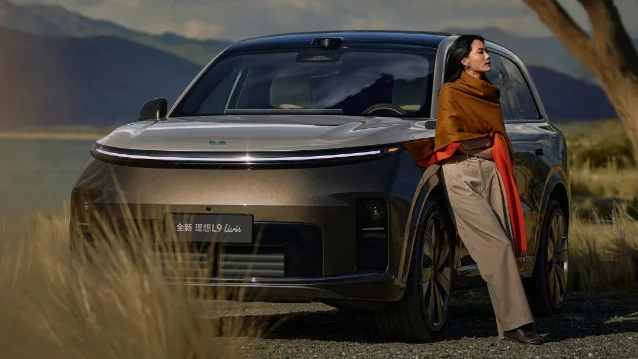
Li Auto's all-new L9 went on sale May 15, 2026, with deliveries starting two days later. The launch marks the second generation of Li Auto's flagship SUV — a nameplate that debuted in 2022 — and introduces the company's first self-developed AI chip series into a production vehicle at the flagship tier. Two trims are on offer: the L9 Ultra at RMB 459,800 (~$67,700) and the L9 Livis at RMB 509,800 (~$75,100). 1
Launch discounts compress those prices: new buyers get RMB 20,000 off; existing Li Auto owners can stack an additional RMB 10,000 trade-in benefit. That puts the effective Livis entry price below RMB 490,000 — notably under the RMB 559,800 pre-sale figure announced at Auto Shanghai in April, a 9% reduction. 2
What changed from the first-generation L9
Li Auto calls the new L9 a "flagship SUV in the era of embodied intelligence" — but underneath the marketing language, the engineering changes are substantial. 3
The powertrain retains the EREV formula — a 1.5-liter turbocharged four-cylinder range-extender paired with dual electric motors — but the generation-3 system now delivers 420 kW of combined output and a 4.9-second 0–100 km/h time. The battery is a 72.7 kWh CATL pack supporting 5C supercharging, enabling CLTC-rated figures of 420 km on electricity alone and 1,650 km combined. The previous L9 topped out at 1,315 km combined range; the jump is meaningful for long-haul use cases where EREV owners actually run on the extender.
The chassis architecture is the bigger departure. Both trims get steer-by-wire and four-wheel steering as standard. The L9 Ultra adds a third-generation dual-cavity air suspension; the L9 Livis steps up to 800V full-active suspension with electromagnetic actuators capable of over 10,000 N of lift per wheel and millisecond response — the feature Li Auto's marketing team describes as "anti-physics" body control. Electronic braking also splits by trim: the Ultra uses electro-hydraulic braking (EHB), while the Livis switches to fully electric mechanical braking (EMB) with multi-layer redundancy.
The chip story: Li Auto's M100
The most strategically significant change in the L9 is under the ADAS hood. Li Auto is now the third Chinese EV maker — after Nio and Xpeng — to field a self-developed intelligent driving chip in a production car. The in-house Mach M100 is built on a 5-nanometer automotive-grade process; a single chip delivers up to 1,280 TOPS. 1
The two trims diverge here: the Ultra gets one M100 paired with a Qualcomm Snapdragon 8797 Max; the Livis gets two M100 chips (2,560 TOPS total) with a Snapdragon 8797 Elite. Li Auto claims the dual-chip configuration delivers three times the compute of Nvidia's Thor-U, which is the chip its main domestic competitors currently rely on. Four lidars and the company's VLA 2.1 vision-language-action model complete the sensor stack; end-to-end processing latency is said to be 40% lower than the previous architecture.
The self-developed chip matters beyond the spec sheet. It cuts dependence on Nvidia's automotive supply chain — a real operational concern for Chinese automakers navigating US export controls — and allows tighter co-design between the VLA model and the silicon it runs on.
Specs at a glance
| L9 Ultra | L9 Livis | |
|---|---|---|
| Price (MSRP) | RMB 459,800 (~$67,700) | RMB 509,800 (~$75,100) |
| Effective price (with launch discount) | From RMB 439,800 | From RMB 489,800 |
| Powertrain | EREV, 420 kW dual-motor | EREV, 420 kW dual-motor |
| CLTC electric range | 420 km | 420 km |
| CLTC combined range | 1,650 km | 1,650 km |
| Charging | 5C, 72.7 kWh CATL | 5C, 72.7 kWh CATL |
| Suspension | Gen-3 air (dual-cavity) | 800V full-active (EMB) |
| Braking | EHB | EMB (full-by-wire) |
| Intelligent driving chip | 1× Mach M100 (1,280 TOPS) | 2× Mach M100 (2,560 TOPS) |
| Cockpit SoC | Snapdragon 8797 Max | Snapdragon 8797 Elite |
| Display | 29" panoramic + 21" 4K rear | 29" panoramic + 21" 4K rear |
| Lidar count | 4 | 4 |
Where this fits in Li Auto's 2026 picture
The L9 launch comes at a complicated moment commercially. Li Auto delivered 34,085 vehicles in April 2026, flat year-on-year but down 17% from March. Through the first four months of 2026, cumulative deliveries of 129,227 units represent only 1.9% growth versus the same period last year. The company's stated 2026 delivery target of roughly 490,000 units — about 20% above 2025's 406,343 — is ambitious given that trajectory. 1
The Livis trim, priced above RMB 500,000 at MSRP, is not a volume driver. It is a halo play: the kind of vehicle that demonstrates technical capability and generates attention disproportionate to its unit sales. The Ultra at RMB 439,800 effective is the trim that will move units in the competitive Chinese luxury SUV bracket — territory where it now squares up against AITO's M9, and indirectly against BMW X7 and Mercedes GLS buyers who are increasingly cross-shopping Chinese options.
International expansion is the other lever. A dedicated international variant of the L9 is planned for Q3 2026, launching first in Central Asia and the Middle East before moving to broader Eurasia markets. Li Auto has also named Zach Zhou — formerly of Chery's European operation and Xpeng's overseas division — as VP for Europe and Managing Director for Benelux. A German R&D center opened in early 2025 handles European type-approval work and powertrain localization. Whether these moves translate into meaningful European sales volume before 2027 is an open question.
For now, the new L9 represents the clearest statement Li Auto has made about the direction it wants to take: a vertically integrated AI-in-the-car stack, built on its own silicon, priced below equivalent German incumbents, and positioned for export as China's EV expansion cycle enters a more selective phase.
Add more perspectives or context around this Drop.